


Animal Ear Tag
Why Choose Us
Quality Control
We have professional personnel to monitor the production process, inspect the products and ensure that the final product meets the required quality level standards, guidelines and specifications.
Advanced Equipment
Our company has professional production of more than 360 blockade equipment, covering an area of more than 10,000 square acres, become a comprehensive and capable enterprise integrating R&D, design, production and sales.
Customized Services
We understand that each customer has unique manufacturing needs. That's why we offer customization options to cater to your specific requirements.
Our Certificates
Many of our products have passed ISO 9001, ISO 14001 certification and OHSAS 18001 certification.
What is Animal Ear Tag
If you didn't know already, an ear tag is a small object made of plastic or metal that pierces the ear of livestock or other animals by way of an applicator. Around the farm, they are visual aids that use numbers, colors, or a combination of both, for organizational purposes. Some ear tags, known as insecticide tags or “fly tags”, even help keep pests like horn and face flies away.On a larger scale, Premise Identification ear tags have been federally mandated on all cattle sold for profit or moved across state lines. They are also used by the National Animal Identification System (NAIS) and the USDA's Animal and Plant Health Inspection Service (APHIS) to track (and help prevent) the spread of diseases, like mad cow or scrapie. This is important information for the farmer who plans to buy or sell livestock.


Benefits of Animal Ear Tag
Identification
Ear tags provide a simple and efficient method of identifying individual animals. Each tag is typically marked with a unique number or code that can be used to track and identify specific animals in a herd. This identification system helps in keeping accurate records of animal health, breeding, and performance.
Traceability
Ear tags play a crucial role in traceability systems for livestock. By having a unique identifier on each animal, it becomes easier to track its movement and monitor its health and origin. In case of disease outbreaks or food safety concerns, the ability to trace animals through their ear tags helps identify and contain the issue quickly.
Management and Record-Keeping
Animal ear tags assist in efficient herd management. By having individual identification, farmers and ranchers can keep detailed records of an animal's health, vaccination history, breeding history, and other important data. This information is valuable for making informed decisions regarding breeding, culling, and healthcare management.
Inventory Management
Ear tags aid in maintaining accurate inventory records of livestock. By quickly scanning or visually checking the ear tags, farmers can determine the number of animals in their herd, track any changes in population, and manage their resources accordingly.
Automated Data Collection
Some ear tags incorporate RFID technology, allowing for automated data collection. RFID tags can be scanned using handheld or stationary readers, which speeds up the process of recording information and reduces the chances of errors associated with manual data entry.
Animal Welfare
Animal ear tags can also contribute to animal welfare. They enable quick identification of individual animals in distress or in need of specific medical attention. Identifying and addressing health issues promptly can help prevent the spread of diseases and ensure the well-being of the animals.
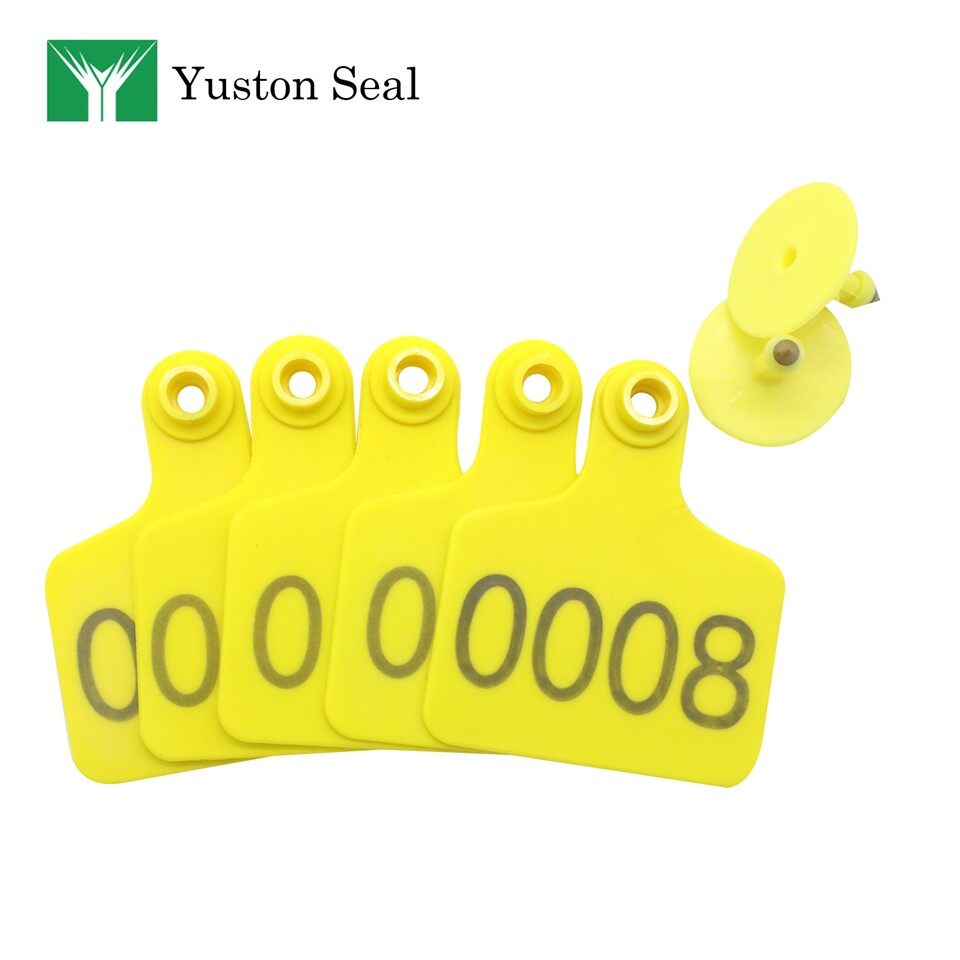
Materials Needed to Use Animal Ear Tags
Ear tags
Choose the appropriate tag based on your specific needs. Cattle ear tags come in various types, such as plastic, metal, flag-shaped and electronic tags. Make sure to select the right tags and colours to suit your preferences.
Tag applicator
Ensure that the applicator is suitable for the type of cattle ear tag you have chosen because some varieties require specific applicators. Some applicators have inbuilt studs and buttons that help to attach certain types of cattle ear tags firmly. Above all, select an applicator that is user-friendly and enables precise tag placement.
Disinfectant solution
The disinfectant solution is used to sterilize the tag applicator and the cow's ears before tagging. Disinfection helps to prevent infections and eliminates the risk of complications.
Record-keeping tools
These tools consist of a pen, paper or a digital device that serves to record accurate information about every tagged animal.
Additional considerations
This may involve a first aid kit and restraint instruments to handle unexpected injuries and secure the animal during tagging.
How to Use Animal Ear Tags
Step 1: Catching and Restricting Movement
Before an ear tag can be applied the animal must be caught and restrained to limit head movement and ensure accurate tag position. When a new calf is born their mother's instinct is to protect them and this is a very helpful sense. However, when it comes to a handler ensuring that the calf gets the necessary attention, it can become dangerous. This is where a calf cage can be helpful. This tool allows the calf to be caught, cared for, and tagged without putting any individuals at risk of injury. Many times a single individual is able to secure the calf to be tagged without help. As the livestock gets older a head gate is required. This allows the animal's head to be secured and the individual tagging to be out of harm's way.
Step 2: Significance or Ear Tag Color
The main reason for using ear tags is to better our ability to identify our livestock. When it comes to the color of tag producers use, there is great significance. Not only is the color important, but the ear that is tagged can also have significant meaning. Each farm can decide on their own method for identifying their cows. For example, a rancher may decide that an orange tag signifies a heifer while a yellow tag signifies a steer, or left ear signifies heifer while right signifies steer. Many combinations can be established with a multitude of meanings. The color and ear choice rely solely on the producer's preferences, however when a choice has been made it is best to stick with it throughout each herd owned.
Step 3: Significance of Identification Number
Another identification tool is assigning a number to each animal. In many operations, there is only a number on each tag but sire, dam, and date of birth can also be added. Numbers are given to help with cattle inventory and are necessary for recording data for different circumstances. With older cows, it can help to identify the approximate breeding date, calving date, health and medical records, calving history, and possibly which pasture she is located. Numbers are used on calves to identify which cow it belongs to, date of birth, vaccinations, and any other concerns. It is important to label clearly and to write the animals identification information as large as possible so that it can be viewed from a distance. When writing on a tag be sure to use a designated tagging marker, regular and permanent markers fade with time and become hard to read.
Step 4: Tag Placement
Once a cow or calf has been chosen, colors are picked, and the identification information is on the tag it is time to start the process. If placed incorrectly, a tag could potentially cause problems, therefore location is very important. The ideal location to place an ear tag is in the middle one-third of the ear. The location should be between the rises in auricular cartilage or the ribs. If a tag is placed too far towards the inside of the ear it will fit tightly due to the presence of thicker cartilage. This may also cause necrosis, the death of cells in the tissue, or sloughing tissue which is the shedding of dead cells. Tags placed too far to the outside of the ear have the possibility to be snagged or ripped out. Proper tag placement is also important to reduce the risk of infection.
How to Choose Animal Ear Tag
Generally, cattle tags are made of three materials: plastic, rubber, and metal. Metal and rubber tags are expensive, so many people prefer plastic for personalization. Plastic also keeps the design for an extended duration.Plastics are not very durable and are more prone to breaking. Using metal tags is not recommended. Such tags are heavier, and the animal may feel uncomfortable having them in its ears. Flexible polyurethane tags are also trendy options for customization. Quick Note: Plastic is a suitable material due to its lightweight nature. Its compromised durability is not an issue, as you can get two tags for one animal. If the first breaks, you can use the second. Remember that these tags are cheap, so having two tags for each animal won't be costly.
Each cattle ranch has its unique logo and branding. You can get those logos and taglines on the cattle tag. You can also add the ranch name, location, and the owner's name. This will give your cattle personalized identification. For example, if any of your calf goes missing, finding it will be easy.If someone finds your missing animal by reading the tag, he will return it to you. Moreover, the logo gives a sense of professionalism. It will show that you are serious about the ranching business. One thing you should do is hire a designer to get the logo. DIY logos give a cheap impression. Hiring will add additional cost, but it is worth it.
Default cattle tags come in limited sizes and shapes. You'll see more circular-shaped tags. But you can customize these sizes and shapes as well. There are no restrictions. During custom ordering, all you will have to do is to mention the size and dimension. The company will make custom-size tags for you.Not only size, but you can make custom shapes. For example, you can get custom tags that look like your brand logo. It will give the tags a more professional look and align with your brand. Many people use different shapes to identify different breeds.One question that arises is: Do these custom shapes require more money? The answer is YES! You're more likely to pay more when you get a bigger size with a custom shape and design. This is because more material and time go into creating a uniquely shaped tag. However, paying a higher price will give you ideal customization.
You can print designs or ranch information on the tags. However, the font for writing that information on the cattle tags should be bold and easy to read. Some companies also offer a front engraved on the tags'body. However, such tags can be costly.You can print barcodes on the tags, not only in font or design. By scanning the bar, one can quickly get information about your ranch. Bar codes are also helpful if you sell your cattle. The buyer can get complete information about the animal by scanning a code.
How to Maintain Animal Ear Tag
Clean the applicator
It's essential that all materials coming into contact with a cow's ear be sterilized properly, so you'll want to clean the applicator to decrease any risk of infection. Not only will it help prevent infection, cleaning and disinfecting the applicator after every tagging session will lengthen its life so that it will work longer. Wipe down the clip and pin components using a disinfection solution like betadine,chlorhexidine, or rubbing alcohol to help eliminate any bacteria that might be present.
Secure the animal
If the animal's head moves, it can make it difficult to apply the ear tag properly, which can cause injury to it or the person applying it. For cattle, it's best to use a chute with a headgate along with a nose lead and halter.
Ensure proper animal ear tag placement
Be sure to apply the animal ear tag properly in the correction location on the ear. It should be locked in place but not too tight or too loose. Avoid applying excessive force, which could create pressure sores. The stud should be inserted completely onto the applicator pin while the button/panel portion goes beneath the opposite clip.check alignment of the tagger by closing the applicator's jaw to the point where the two halves meet, ensuring that the stud is centered with the hole. Position the applicator on the animal's ear at the place it will be tagged, firmly close the applicator and quickly release. Check that the animal ear tag is placed comfortably, correctly, and securely.
Regular cleaning
It's important to clean around the animal ear tag to ensure the animals stay healthy. That means you'll need to provide a topical application of hydrogen peroxide to the ear animal ear tag puncture and ear daily for five to seven days after applying to prevent infection. Applying additional applications in the following weeks is advised until the ear has completely healed.
Our Factory
Shandong Yuston New Material Co., Ltd.Quality supplier is located in the beautiful coast of Bohai sea - Dezhou, China. It is an integrated and high-level enterprise with the ability to research and development, design, produce, and sales; and it has professional factory which produce plastic seals, stopcock, cable seals, meter seals, bolt seals, RFID electronic seals, plastic cable seals, containers, and GPS seals. Yutong is an excellent manufacturer and exporter of security seals in China.


Certificate


FAQ
As one of the leading animal ear tag manufacturers and suppliers in China, we warmly welcome you to buy high-grade animal ear tag for sale here from our factory. All our products are with high quality and competitive price.
Livestock Ear Tags, Ear Tags For Livestock, Cow Number Tags